Article
6 minute readAI Citation Audit: Does the Source Really Support the Answer?
Run an AI citation audit to see whether linked sources really support each claim. Split claims, read the passages and label the evidence.
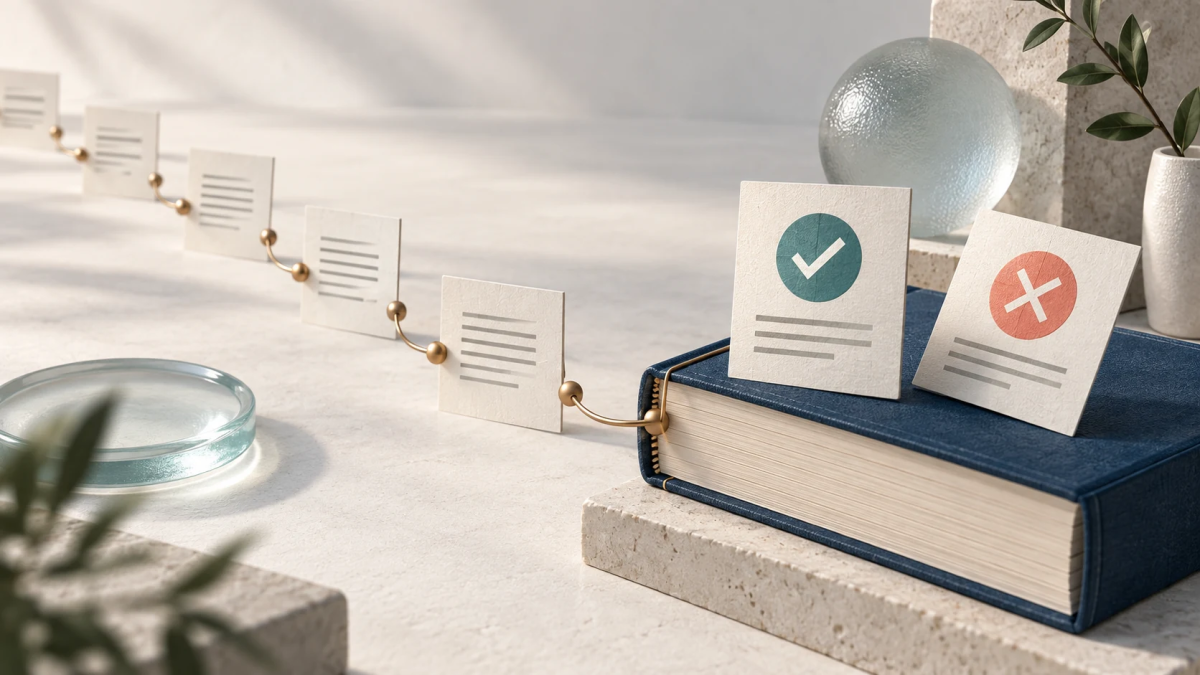
An AI citation audit answers one simple question: does the linked source actually support the sentence next to it? A citation makes an answer look supported. However, the page may cover only part of the claim, a different question or nothing relevant at all.
This guide shows why citations often decorate rather than support, how to split and label claims, and how to use the results for your own content. As a result, you will know which AI claims you can repeat, which ones you should correct and which ones you should ignore.
Why citations decorate more than they support
How generated answers place citations is not publicly documented in detail. One possibility is that the system finds relevant documents rather than the exact sentence that proves each claim. If so, a source retrieved for one part of the answer may be shown next to another. Alternatively, the model may have written a conclusion the source never draws.
From the reader's side, all of these look identical: a credible domain next to a confident sentence. In fact, people, including editors, trust a claim with a link far more than one without, yet rarely open the link.
Therefore, treat every citation as a hypothesis about support, to be tested by reading. Once you do, the answer's persuasive tone stops counting as evidence.
Split compound claims first
An answer might say a product is inexpensive, works offline and suits regulated teams, followed by one citation. Treat that as three separate claims. The page may support the price but say nothing about offline use or compliance.
Also record where the supporting passage sits and any conditions attached to it. A link to a broad homepage is not the same as a specific, documented feature statement.
Label evidence with four values
A small, fixed set of labels keeps audits consistent across reviewers. Use the four values in the table below for every claim, and add a one-line reason.
| Label | Meaning |
|---|---|
| Supported | The source substantiates the claim with matching scope |
| Partially supported | Only part of the claim is established |
| Contradicted | The source states incompatible information |
| Unverifiable | The source is unavailable or insufficient |
Keep relevance and support apart
Relevance and support are different tests. A relevant article can still fail to support the particular assertion attached to it, so score them separately.
Likewise, "unverifiable" describes this citation, not the world. Offline mode may exist and be documented elsewhere. The audit only asks whether this link supports this sentence, and that question has value on its own.
Run a repeatable AI citation audit
The procedure below takes about as long as reading the sources carefully. That is the point, because no shortcut can skip the reading:
- Decompose: split the answer into atomic claims, and give every number, superlative or condition its own row.
- Attach: note which citation sits nearest each claim and whether the placement is explicit or merely adjacent.
- Retrieve: open each cited page and save a dated copy, because pages change.
- Locate: find the passage that would support the claim and record its exact wording.
- Compare scope: check that the passage matches the claim's population, time, product version and conditions.
- Label: apply one of the four values with a short reason.
- Summarize: count the labels and list contradicted and unverifiable claims first.
Run the same steps for every answer you audit. Consequently, results from different reviewers and different months stay comparable.
Worked example: a misleading comparison
Imagine a hypothetical answer that says, "Example Board is the cheapest option for teams of 20", citing a pricing page. That page may list prices. However, "cheapest" also needs current, comparable prices for every alternative under the same billing terms.
So the citation supports one input to a comparison, not the superlative itself. The table below shows how the audit labels this answer and its other claims.
| Claim | Cited passage | Label | Reason |
|---|---|---|---|
| Example Board is the cheapest option for teams of 20 | "Team plan: $8 per user per month" | Partially supported | Price is there; the comparison is not |
| It works offline | Pricing page; no mention | Unverifiable | Source does not address the claim |
| Suits regulated teams | "SOC 2 report available on request" | Partially supported | One control mentioned; the claim is broader |
Check dates and populations
Research citations need a matching sample, period and measurement. For example, a study of selected websites cannot support a claim about all businesses. Similarly, an old product test may not describe the current version.
If the page changed after the answer was generated, document the gap in observation dates. Avoid accusing the answer of inventing a fact when the source's history is simply unknown.
Use the audit results
For answers about your own product, the audit gives you a work list. Partially supported or contradicted claims point to pages where the fact is missing, vague or wrong, so the fix is on your side.
Meanwhile, unverifiable claims that cite your domain suggest the fact is not where a system would look for it. That is usually a structure problem rather than a content problem.
For answers about anyone else, the audit decides what you can repeat. Repeat a partially supported claim only at its supported scope, and never repeat a contradicted one. Treat an unverifiable claim as unsupported until you find a source that does support it and cite that source directly.
Use AI as an audit assistant
A model can help with splitting claims and locating passages, as long as you supply both the answer and the source text. Use the prompt below only after you add those records.
Audit each claim against its attached source text only. Return supported, partially supported, contradicted or unverifiable, with the relevant passage location and missing condition. Do not substitute another source without labeling it separately.Keep the model on the supplied text. If it fetches a different source and quietly marks the claim "supported", the question has changed from "does this citation support this claim" to "could anything support it". Those are different audits.
Log every claim in a worksheet
Copy the worksheet columns below into a spreadsheet to run your AI citation audit, and keep one row per claim. The filled row is an illustrative example, not a customer result, so replace it with your own records.
| Claim ID | Answer claim | Attached URL | Source location | Evidence label | Missing condition | Reviewer |
|---|---|---|---|---|---|---|
| C01 | Cheapest for 20 users | Pricing URL | Plan table | Partially supported | Competitor prices and billing assumptions | Pending |
Cite well in your own content
The same standard applies to what you publish. So keep each supporting link close to the statement it supports, and explain the evidence in plain language.
In other words, a good citation helps a reader verify the claim. It should never just decorate a paragraph with a credible domain name.
Conclusion
An AI citation audit replaces trust in appearances with evidence. Split each answer into claims, read the cited passages, compare scope and label every claim with one of four values.
In short, a link is a hypothesis until you read it. Take one AI answer about your product this week, audit its citations and fix the first page where a fact is missing or wrong.
Sources
These sources informed the research for this guide. The checklist, examples and workflow are independently written and are not results of a SEOVision experiment.
- Self-Promotional Content Works—Until It Backfires (AI SEO Experiment): research starting point, not an endorsement of this workflow
- Why ChatGPT Cites One Page Over Another (Study of 1.4M Prompts): research starting point, not an endorsement of this workflow
Frequently asked questions
Quick answers to the questions readers ask most about this topic.
Does a citation in an AI answer prove the claim?
No. The citation may support only part of the claim, a different question or nothing relevant. Open the source and compare the exact wording.
What labels should I use in a citation audit?
Use four: supported, partially supported, contradicted and unverifiable. Add a one-line reason for each claim.
What does "unverifiable" mean?
It means this specific source does not establish the claim. The fact may still be true and documented elsewhere.
Can AI run the audit for me?
It can help split claims and find passages in the text you supply. A person should still check consequential claims and keep the model from swapping sources.
Sources
These references support the platform guidance discussed above. Worked examples are illustrative unless identified as measured results.
Keep reading
Read next

Article 6 min read
Hallucinated Links in AI Answers: Diagnose and Fix Broken URLs
Hallucinated links in AI answers can point to pages that never existed. Find the origin, triage each URL and redirect only to verified equivalents.

Article 6 min read
How to Update Outdated Content Without Faking Freshness
Learn how to update outdated content for real: diagnose what changed, choose the right action, build an evidence-based queue and finish every fix.

Article 6 min read
Create a Consistent Product Identity Across the Web
Create a consistent product fact sheet across your website and third-party profiles so buyers can verify names, features and availability.